In the chemical industry, downcycles don’t remove pressure—they redirect it.
When commodity prices dip or demand slows, procurement teams feel it quickly. Budgets get tighter, inventory gets watched more closely, and every raw material decision carries more scrutiny. For chemical manufacturers and industrial processors, protecting margin becomes the priority.
It’s tempting to sit still in a softer market. Wait for pricing to settle. Reduce purchasing activity. Stick with the same suppliers and hope stability returns.
Experienced chemical buyers know to resist that temptation, because a downcycle is when sourcing strategy matters most.
The Limits of Prime-Only Chemical Sourcing
Prime chemical materials are essential in many applications, no question. The issue isn’t whether they have value—it’s relying on them exclusively.
When the broader chemical market tightens, primary producers adjust. Allocations shift. Credit terms can narrow. Lead times can change. Even in a soft demand environment, upstream adjustments can affect availability and pricing structures.
For chemical buyers, that kind of exposure can strain already thin margins. If your sourcing strategy runs through one channel, you don’t have much room to adjust when that channel tightens.
And in a downcycle, flexibility is leverage.
Where Secondary and Beneficial Reuse Materials Fit
Within the chemical industry, secondary chemical materials and Beneficial Reuse streams are often misunderstood. They’re sometimes viewed as inconsistent or short-term options.
In reality, many of these materials come from controlled industrial processes. They’re viable chemical inputs that fall outside a producer’s primary sales channel but remain suitable for the right applications.
For cost-sensitive buyers, that matters.
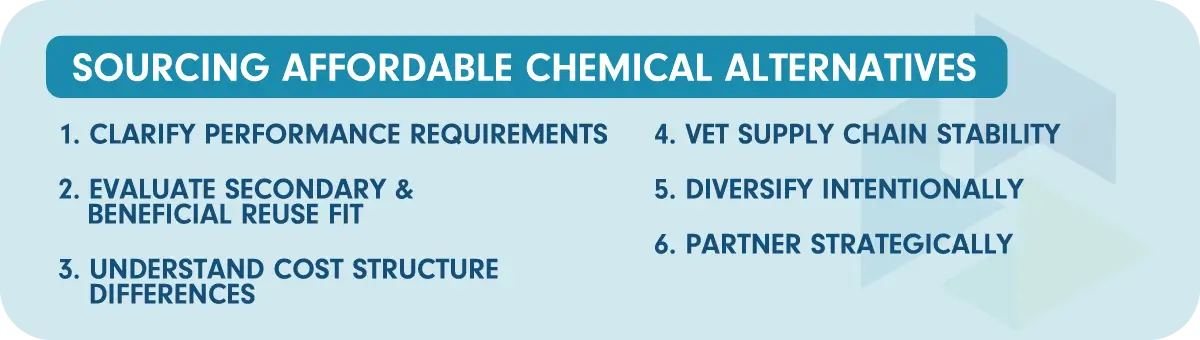
In many cases, the priority is performance at the right price point. Secondary chemical products can meet those needs while operating on a different cost structure than prime materials. That difference can translate into meaningful savings.
There’s also a practical advantage during uncertain markets. Secondary streams are not always tied as tightly to traditional pricing benchmarks. That can create steadier purchasing options when prime markets are shifting.
Incorporating these materials isn’t about lowering standards. It’s about understanding your specifications clearly and recognizing where flexibility exists.
The Role of a Strong Chemical Distributor
Alternative supply only works if it’s supported by experience and infrastructure.
In a volatile market, chemical sourcing isn’t just about finding products. It’s about moving them reliably, structuring terms appropriately, and solving problems quickly when something changes.
A chemical distributor with access to both prime and secondary products has more ways to respond when conditions shift. If one supply channel tightens, another may still be open. If pricing structures change, there may be room to rebalance the mix.
Credit strength matters more in a downcycle. Logistics matter more. Cross-border relationships matter more. Buyers need partners who can move material efficiently and who understand how different supply streams behave under pressure.
Looking for a partner like that? Talk to Meadows today.
Building Stability Into Your Chemical Sourcing Strategy
Downcycles have a way of exposing gaps in a sourcing model. Companies that rely too heavily on a single type of material or a single supplier often feel the impact first. Those that build a more balanced approach—blending prime and secondary chemical inputs where appropriate—tend to operate more steadily through volatility.
This doesn’t mean replacing prime materials across the board. It means taking a closer look at where alternatives are technically viable and commercially sensible.
Commodity cycles are not new to the chemical industry. They are part of doing business. The companies that stay competitive through those cycles are usually the ones that plan for them, not react to them.
When the market turns again (and it will), the buyers who built flexibility into their chemical supply chain will be in a stronger position than those who simply waited for conditions to improve.
Our team can help you get started with a better sourcing strategy today.