• Skip to main content
  • Why Meadows Chemical
  • Beneficial Reuse
  • Products
  • Markets
  • Company
    • About Us
    • News
    • Careers
  • Resources
  • Contact
  • Why Meadows Chemical
  • Beneficial Reuse
  • Products
  • Markets
  • Company
  • Resources
  • Contact

NP-9 (Nonylphenol Ethoxylate): Industrial Uses, Specs & Supplier Guide

A high-performance nonionic surfactant for emulsification, wetting, and detergency across chemical manufacturing, cleaning, and oil & gas applications.

NP-9 is one of those chemicals that doesn’t get much attention outside the industries that depend on it—but for formulators and process engineers who rely on consistent surface activity and chemical stability, it’s a go-to ingredient. From industrial cleaning concentrates to oilfield chemistry, NP-9 earns its place in demanding formulations by doing its job reliably, batch after batch.

At Meadows Chemical, we supply NP-9 in both prime and secondary grades, giving customers the flexibility to balance performance requirements with cost management. Whether you’re sourcing for a new product launch or keeping a long-running process stocked, we’re built to keep your supply chain moving.

What Is NP-9 (Nonylphenol Ethoxylate)?

NP-9, short for Nonylphenol Ethoxylate 9-mol, is a nonionic surfactant produced by reacting nonylphenol with approximately nine moles of ethylene oxide. The result is a molecule with a hydrophobic nonylphenol tail and a hydrophilic ethoxylate chain—a structure that gives NP-9 its ability to reduce surface tension, stabilize emulsions, and improve the wetting behavior of aqueous systems.

It belongs to the broader nonylphenol ethoxylate (NPE) family, which includes a range of products differentiated by their degree of ethoxylation (the number of ethylene oxide units). The 9-mol variant sits in a sweet spot for many industrial applications: water-soluble, effective across a wide pH range, and compatible with a wide range of formulation chemistries.

How NP-9 Works

NP-9’s effectiveness comes down to its molecular structure. Like all surfactants, it has a dual nature: one end of the molecule is attracted to water (hydrophilic), while the other is attracted to oils and nonpolar substances (hydrophobic). When NP-9 is introduced into a system, these two ends orient themselves at the interface between water and oil—or between a liquid and a solid surface—reducing the energy barrier that normally keeps those phases separate.

In practical terms, this means NP-9 can:

  • Lower surface tension, allowing liquids to spread more easily across surfaces and penetrate porous materials
  • Emulsify oils and water, stabilizing mixtures that would otherwise separate
  • Improve wetting, helping liquid formulations make full contact with surfaces rather than beading up
  • Enhance detergency, assisting in lifting and suspending soils, greases, and contaminants

Because it’s nonionic—carrying no electrical charge—NP-9 is compatible with anionic, cationic, and other nonionic surfactants, as well as with electrolytes. That compatibility gives formulators a lot of flexibility in how they build their systems.

Key Properties and Specifications

NP-9 is sold under various trade names across the industry. You may encounter it listed as:

  • NP-9
  • Nonylphenol Ethoxylate 9-mol
  • NPE-9
  • Igepal CO-630 (legacy trade name)
  • Tergitol NP-9 (legacy trade name)

CAS #: 9016-45-9

Chemical Formula: C₁₅H₂₄O(C₂H₄O)₉

Appearance: Clear to slightly hazy liquid

Purity Range: Typically 99%

Packaging Options: Drums, totes, bulk shipments

Certifications: Available upon request

Get a Quote

Applications and Industries

Woman with safety goggles and hair net working in chemical facility adding liquid product to large mixer.

Chemical Manufacturing

In chemical manufacturing, NP-9 serves as an emulsifier and wetting agent in a wide range of production processes. It helps stabilize emulsion polymerization reactions, where controlling droplet size and distribution is critical to achieving consistent product quality. It also functions as a processing aid in the manufacture of specialty chemicals, agricultural formulations, and industrial intermediates.

For formulators, NP-9 provides a reliable way to bring incompatible ingredients into stable, homogenous systems—reducing phase separation and improving shelf stability in finished products.
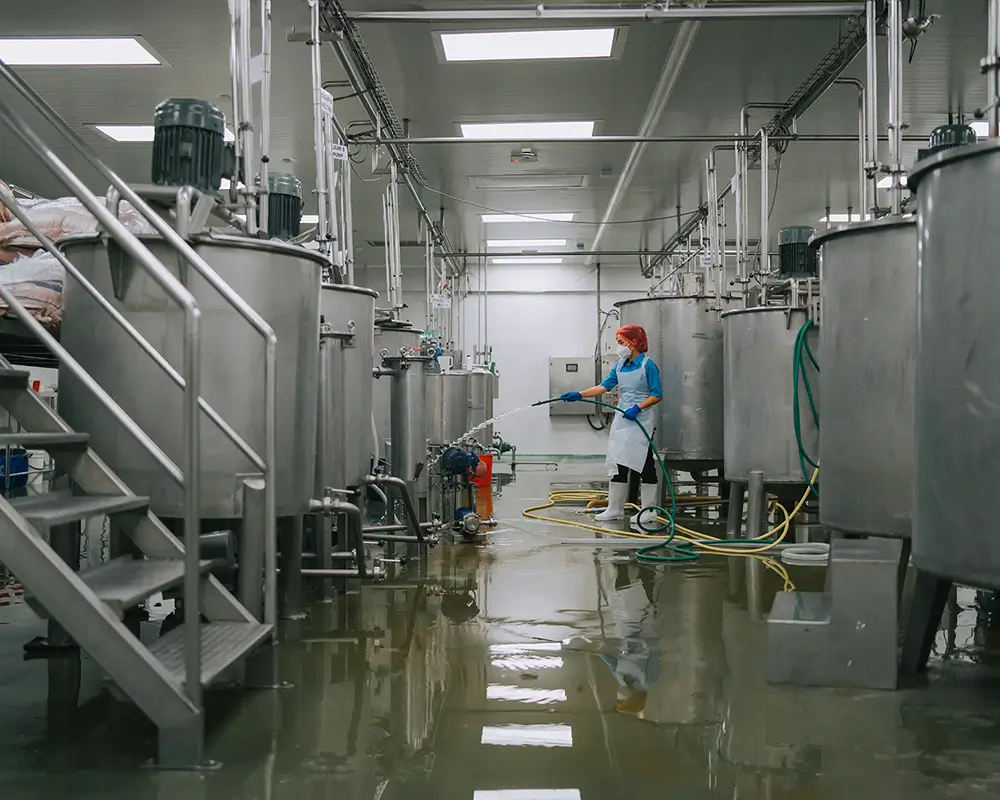
Wide shot of a row of elevated industrial containers; a person in safety gear is shown washing the equipment with a stream of liquid coming out of a hose.

Cleaning Product Manufacturing

NP-9 is a well-established ingredient in industrial and institutional cleaning formulations. Its ability to wet surfaces quickly and emulsify oils makes it effective in heavy-duty degreasers, hard-surface cleaners, and industrial laundry products. It works well in concentrated alkaline systems and maintains its activity across a range of temperatures and dilution levels.

You’ll find NP-9 contributing to products such as:

  • Janitorial cleaning concentrates
  • Industrial degreasers and parts cleaners
  • Institutional floor and surface cleaners
  • Car wash and vehicle cleaning concentrates
  • Textile scouring agents
Top drive system (TDS) is a motorized unit suspended from the derrick to rotate the drill string, revolutionizing drilling by enabling faster, safer operations by replacing the traditional rotary table and Kelly system.

Oil & Gas

In oilfield operations, surfactants like NP-9 play important roles in well stimulation, enhanced oil recovery, and production chemistry. NP-9 is used as an emulsifier and wetting agent in drilling fluids, where it helps manage the interaction between the water and oil phases and improves the lubrication of drill strings. It also appears in completion fluids, stimulation treatments, and tank cleaning operations.

Its chemical stability across a range of temperatures and its compatibility with the mineral-rich environments found in oilfield applications make it a practical choice for field chemistry.

NP-9 vs. Other Surfactants: What Sets It Apart

Understanding where NP-9 fits relative to alternative surfactants helps formulators make better sourcing and formulation decisions.

NP-9 vs. Linear Alcohol Ethoxylates (LAE): Alcohol ethoxylates have become more common as a replacement for NPEs in certain consumer-facing applications due to regulatory trends. However, NP-9 still offers performance advantages in many industrial systems—particularly in emulsion polymerization and high-electrolyte environments—where alcohol ethoxylates can fall short. For industrial applications where regulatory pressure is lower, NP-9 remains a cost-effective and high-performing option.

NP-9 vs. Other NPE Grades (NP-4, NP-10, NP-40): The degree of ethoxylation determines the balance between hydrophilic and hydrophobic character. Lower-mol variants like NP-4 are more oil-soluble and commonly used in oil-in-water emulsification. Higher-mol variants like NP-40 are more water-soluble and better suited for certain detergency applications. NP-9 sits in the middle, making it versatile across a wide range of systems and one of the most widely used grades.

NP-9 vs. Anionic Surfactants: Anionic surfactants like LABSA and SLS are highly effective for foaming and detergency but can be sensitive to hard water and electrolytes. NP-9’s nonionic nature makes it electrolyte-tolerant and non-foaming or low-foaming depending on application conditions—an advantage in systems where foam control is important.

Why Source NP-9 Through Meadows Chemical?

Finding a reliable NP-9 supplier isn’t just about getting product on a truck. It’s about working with a partner who understands your supply chain, can flex with your demand, and won’t leave you scrambling when the market tightens.

At Meadows Chemical, we’ve spent more than a decade building the supplier relationships, logistics infrastructure, and market knowledge to deliver on that promise. For NP-9, that means:

  • Both prime and secondary grades available, giving you options to optimize for performance, cost, or both
  • Flexible packaging, from drums and totes to bulk shipments, to fit your receiving and storage capabilities
  • Consistent availability backed by strong supplier relationships and proactive inventory management
  • Fast, logistics-driven delivery to minimize lead times and reduce supply disruptions
  • Expert support from a team that understands surfactant chemistry and can help you find the right grade for your application

Our customers in chemical manufacturing, cleaning product production, and oil & gas operations rely on us not just to fill orders, but to help keep their businesses running without interruption.

Explore Our Full Chemical Supply

FAQs

What is NP-9 used for?

NP-9 (Nonylphenol Ethoxylate 9-mol) is a nonionic surfactant used primarily for its emulsifying, wetting, and detergency properties. It appears in industrial cleaning formulations, chemical manufacturing processes, emulsion polymerization, and oilfield chemistry, among other applications.

Is NP-9 water-soluble?

Yes. NP-9 is water-soluble, which makes it effective in aqueous formulations. Its water solubility, combined with compatibility with a wide range of other ingredients, is one reason it remains widely used in industrial cleaning and chemical processing applications.

What is the difference between NP-9 and other NPE grades?

The number in the name refers to the degree of ethoxylation—how many ethylene oxide units are attached to the nonylphenol molecule. Lower-mol grades (like NP-4) are more oil-soluble and better for certain emulsification applications. Higher-mol grades (like NP-40) are more water-soluble and suited for different detergency uses. NP-9 falls in the middle and is one of the most commonly used grades across industrial applications.

The Bottom Line on NP-9

NP-9 has earned its place in industrial chemistry because it delivers consistent surfactant performance across a wide range of demanding applications. Whether you’re formulating a cleaning product, running an emulsion polymerization process, or managing oilfield chemistry, its combination of wetting, emulsification, and detergency gives formulators a reliable and versatile tool.

And when you need a supplier who can match that reliability in your supply chain, Meadows Chemical is ready to help.

Talk to Meadows Today

A high-performance nonionic surfactant for emulsification, wetting, and detergency across chemical manufacturing, cleaning, and oil & gas applications.

NP-9 is one of those chemicals that doesn’t get much attention outside the industries that depend on it—but for formulators and process engineers who rely on consistent surface activity and chemical stability, it’s a go-to ingredient. From industrial cleaning concentrates to oilfield chemistry, NP-9 earns its place in demanding formulations by doing its job reliably, batch after batch.

At Meadows Chemical, we supply NP-9 in both prime and secondary grades, giving customers the flexibility to balance performance requirements with cost management. Whether you’re sourcing for a new product launch or keeping a long-running process stocked, we’re built to keep your supply chain moving.

What Is NP-9 (Nonylphenol Ethoxylate)?

NP-9, short for Nonylphenol Ethoxylate 9-mol, is a nonionic surfactant produced by reacting nonylphenol with approximately nine moles of ethylene oxide. The result is a molecule with a hydrophobic nonylphenol tail and a hydrophilic ethoxylate chain—a structure that gives NP-9 its ability to reduce surface tension, stabilize emulsions, and improve the wetting behavior of aqueous systems.

It belongs to the broader nonylphenol ethoxylate (NPE) family, which includes a range of products differentiated by their degree of ethoxylation (the number of ethylene oxide units). The 9-mol variant sits in a sweet spot for many industrial applications: water-soluble, effective across a wide pH range, and compatible with a wide range of formulation chemistries.

How NP-9 Works

NP-9’s effectiveness comes down to its molecular structure. Like all surfactants, it has a dual nature: one end of the molecule is attracted to water (hydrophilic), while the other is attracted to oils and nonpolar substances (hydrophobic). When NP-9 is introduced into a system, these two ends orient themselves at the interface between water and oil—or between a liquid and a solid surface—reducing the energy barrier that normally keeps those phases separate.

In practical terms, this means NP-9 can:

  • Lower surface tension, allowing liquids to spread more easily across surfaces and penetrate porous materials
  • Emulsify oils and water, stabilizing mixtures that would otherwise separate
  • Improve wetting, helping liquid formulations make full contact with surfaces rather than beading up
  • Enhance detergency, assisting in lifting and suspending soils, greases, and contaminants

Because it’s nonionic—carrying no electrical charge—NP-9 is compatible with anionic, cationic, and other nonionic surfactants, as well as with electrolytes. That compatibility gives formulators a lot of flexibility in how they build their systems.

Key Properties and Specifications

NP-9 is sold under various trade names across the industry. You may encounter it listed as:

  • NP-9
  • Nonylphenol Ethoxylate 9-mol
  • NPE-9
  • Igepal CO-630 (legacy trade name)
  • Tergitol NP-9 (legacy trade name)

CAS #: 9016-45-9

Chemical Formula: C₁₅H₂₄O(C₂H₄O)₉

Appearance: Clear to slightly hazy liquid

Purity Range: Typically 99%

Packaging Options: Drums, totes, bulk shipments

Certifications: Available upon request

Get a Quote

Applications and Industries

Woman with safety goggles and hair net working in chemical facility adding liquid product to large mixer.

Chemical Manufacturing

In chemical manufacturing, NP-9 serves as an emulsifier and wetting agent in a wide range of production processes. It helps stabilize emulsion polymerization reactions, where controlling droplet size and distribution is critical to achieving consistent product quality. It also functions as a processing aid in the manufacture of specialty chemicals, agricultural formulations, and industrial intermediates.

For formulators, NP-9 provides a reliable way to bring incompatible ingredients into stable, homogenous systems—reducing phase separation and improving shelf stability in finished products.

Wide shot of a row of elevated industrial containers; a person in safety gear is shown washing the equipment with a stream of liquid coming out of a hose.

Cleaning Product Manufacturing

NP-9 is a well-established ingredient in industrial and institutional cleaning formulations. Its ability to wet surfaces quickly and emulsify oils makes it effective in heavy-duty degreasers, hard-surface cleaners, and industrial laundry products. It works well in concentrated alkaline systems and maintains its activity across a range of temperatures and dilution levels.

You’ll find NP-9 contributing to products such as:

  • Janitorial cleaning concentrates
  • Industrial degreasers and parts cleaners
  • Institutional floor and surface cleaners
  • Car wash and vehicle cleaning concentrates
  • Textile scouring agents
Top drive system (TDS) is a motorized unit suspended from the derrick to rotate the drill string, revolutionizing drilling by enabling faster, safer operations by replacing the traditional rotary table and Kelly system.

Oil & Gas

In oilfield operations, surfactants like NP-9 play important roles in well stimulation, enhanced oil recovery, and production chemistry. NP-9 is used as an emulsifier and wetting agent in drilling fluids, where it helps manage the interaction between the water and oil phases and improves the lubrication of drill strings. It also appears in completion fluids, stimulation treatments, and tank cleaning operations.

Its chemical stability across a range of temperatures and its compatibility with the mineral-rich environments found in oilfield applications make it a practical choice for field chemistry.

NP-9 vs. Other Surfactants: What Sets It Apart

Understanding where NP-9 fits relative to alternative surfactants helps formulators make better sourcing and formulation decisions.

NP-9 vs. Linear Alcohol Ethoxylates (LAE): Alcohol ethoxylates have become more common as a replacement for NPEs in certain consumer-facing applications due to regulatory trends. However, NP-9 still offers performance advantages in many industrial systems—particularly in emulsion polymerization and high-electrolyte environments—where alcohol ethoxylates can fall short. For industrial applications where regulatory pressure is lower, NP-9 remains a cost-effective and high-performing option.

NP-9 vs. Other NPE Grades (NP-4, NP-10, NP-40): The degree of ethoxylation determines the balance between hydrophilic and hydrophobic character. Lower-mol variants like NP-4 are more oil-soluble and commonly used in oil-in-water emulsification. Higher-mol variants like NP-40 are more water-soluble and better suited for certain detergency applications. NP-9 sits in the middle, making it versatile across a wide range of systems and one of the most widely used grades.

NP-9 vs. Anionic Surfactants: Anionic surfactants like LABSA and SLS are highly effective for foaming and detergency but can be sensitive to hard water and electrolytes. NP-9’s nonionic nature makes it electrolyte-tolerant and non-foaming or low-foaming depending on application conditions—an advantage in systems where foam control is important.

Why Source NP-9 Through Meadows Chemical?

Finding a reliable NP-9 supplier isn’t just about getting product on a truck. It’s about working with a partner who understands your supply chain, can flex with your demand, and won’t leave you scrambling when the market tightens.

At Meadows Chemical, we’ve spent more than a decade building the supplier relationships, logistics infrastructure, and market knowledge to deliver on that promise. For NP-9, that means:

  • Both prime and secondary grades available, giving you options to optimize for performance, cost, or both
  • Flexible packaging, from drums and totes to bulk shipments, to fit your receiving and storage capabilities
  • Consistent availability backed by strong supplier relationships and proactive inventory management
  • Fast, logistics-driven delivery to minimize lead times and reduce supply disruptions
  • Expert support from a team that understands surfactant chemistry and can help you find the right grade for your application

Our customers in chemical manufacturing, cleaning product production, and oil & gas operations rely on us not just to fill orders, but to help keep their businesses running without interruption.

Explore Our Full Chemical Supply

FAQs

What is NP-9 used for?

NP-9 (Nonylphenol Ethoxylate 9-mol) is a nonionic surfactant used primarily for its emulsifying, wetting, and detergency properties. It appears in industrial cleaning formulations, chemical manufacturing processes, emulsion polymerization, and oilfield chemistry, among other applications.

Is NP-9 water-soluble?

Yes. NP-9 is water-soluble, which makes it effective in aqueous formulations. Its water solubility, combined with compatibility with a wide range of other ingredients, is one reason it remains widely used in industrial cleaning and chemical processing applications.

What is the difference between NP-9 and other NPE grades?

The number in the name refers to the degree of ethoxylation—how many ethylene oxide units are attached to the nonylphenol molecule. Lower-mol grades (like NP-4) are more oil-soluble and better for certain emulsification applications. Higher-mol grades (like NP-40) are more water-soluble and suited for different detergency uses. NP-9 falls in the middle and is one of the most commonly used grades across industrial applications.

The Bottom Line on NP-9

NP-9 has earned its place in industrial chemistry because it delivers consistent surfactant performance across a wide range of demanding applications. Whether you’re formulating a cleaning product, running an emulsion polymerization process, or managing oilfield chemistry, its combination of wetting, emulsification, and detergency gives formulators a reliable and versatile tool.

And when you need a supplier who can match that reliability in your supply chain, Meadows Chemical is ready to help.

Talk to Meadows Today

April 16, 2026 by

How Can Meadows Chemical Help You?

This field is for validation purposes and should be left unchanged.
Name(Required)

Meadows Chemical is a Houston-based company with 25+ years of experience distributing industrial chemicals, solvents, and petroleum-based products. We proudly represent 30+ trusted manufacturers and serve customers across the globe.


9575 Katy Freeway, Ste 100
Houston, Texas 77024
  • Why Meadows Chemical
  • Beneficial Reuse
  • Products
  • Markets
  • Company
  • Resources
  • Contact
Cookie Consent
To provide the best experiences, we use technologies like cookies to store and/or access device information. Consenting to these technologies will allow us to process data such as browsing behavior or unique IDs on this site. Not consenting or withdrawing consent, may adversely affect certain features and functions.
Functional Always active
The technical storage or access is strictly necessary for the legitimate purpose of enabling the use of a specific service explicitly requested by the subscriber or user, or for the sole purpose of carrying out the transmission of a communication over an electronic communications network.
Preferences
The technical storage or access is necessary for the legitimate purpose of storing preferences that are not requested by the subscriber or user.
Statistics
The technical storage or access that is used exclusively for statistical purposes. The technical storage or access that is used exclusively for anonymous statistical purposes. Without a subpoena, voluntary compliance on the part of your Internet Service Provider, or additional records from a third party, information stored or retrieved for this purpose alone cannot usually be used to identify you.
Marketing
The technical storage or access is required to create user profiles to send advertising, or to track the user on a website or across several websites for similar marketing purposes.
Manage options Manage services Manage {vendor_count} vendors Read more about these purposes
View preferences
{title} {title} {title}