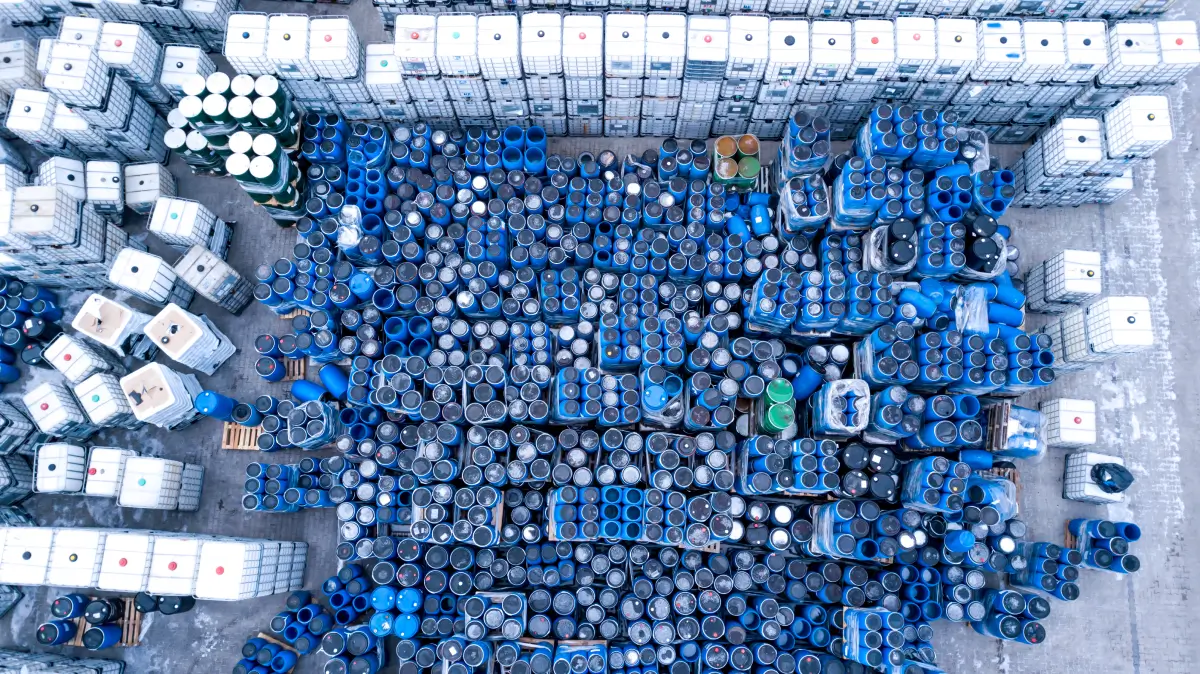
If you walk the floor of most chemical plants or distribution facilities, you’ll find: pallets of off-spec products, overstock from a procurement cycle that didn’t go as planned, or material that’s been sitting in a corner because no one’s sure what to do with it.
It’s easy to write that inventory off as a sunk cost—or worse, budget for disposal and move on. Chances are, you’re one of many plant managers doing exactly that.
But here’s the thing: that material has a market. And for a lot of operations, what’s sitting on that shelf is working capital that just needs to be unlocked.
The Hidden Cost of Sitting on Surplus
Surplus and off-spec inventory works against you in ways that aren’t always obvious.
- There’s the physical space it occupies.
- There’s the carrying cost.
- There’s the compliance overhead of managing material that doesn’t have a clear home.
And in a tight market, there’s the opportunity cost of capital that could be redeployed somewhere more useful.
Finance-minded buyers and plant managers are increasingly looking at inventory not just as an operational issue, but as a balance sheet issue. When you frame it that way, the conversation changes. This isn’t just about tidying up—it’s about recovering value.
Off-Spec Doesn’t Mean Worthless
One of the biggest misconceptions in chemical procurement is that off-spec material has no market. That’s rarely true.
Off-spec is context-dependent—a product that doesn’t meet specification for one application can be exactly what someone else needs. The challenge is knowing where that market is and having the relationships to move material quickly and compliantly.
This is where a distribution partner with real secondary market expertise makes the difference. It’s not just about finding a buyer—it involves evaluating what you have, understanding where it fits, and handling the handoff that keeps you clean from a regulatory and documentation standpoint.
If you want to understand how that evaluation and reassignment process actually works, this is a good place to start.
Reframing the Chemical Inventory Conversation
The default move with surplus inventory is to treat it like a problem to solve: get it out of your warehouse and move on. That approach has a cost, and usually it’s yours to absorb.
Instead, stop and ask: Where does this material have value?
You’ll start an entirely different conversation—one that ends with a recovery instead of an invoice.
Disposal costs are climbing, and in a market where margins are already thin, the difference between writing inventory off and recovering value from it shows up directly on the balance sheet. That’s worth a conversation before you sign off on a disposal budget.
What to Look For in a Distribution Partner
Not every distributor is set up to handle this kind of work. Moving secondary material requires a different skill set than standard procurement.
You need someone who:
- can evaluate product quality honestly
- has active buyers across a range of applications
- can move quickly without creating compliance headaches
It’s also important to work with a distributor who will tell you the truth about what materials are worth upfront. The right partner gives you a realistic picture early so you can plan accordingly.
How Meadows Puts Stagnant Inventory to Work
Meadows works in the secondary market every day. We know where off-spec material moves, what it’s worth, and how to get it there without creating headaches on your end. If you’ve got inventory sitting longer than it should, we can give you a straight answer on what your options are—and move quickly if there’s a fit.